Wow, another 12 months has gone already? Apparently so. Thanks again for everyone who reads this blog, I love reading your comments. Apologies I've posted so few reviews this year. I'm going to try and get ahead this weekend so I can get back to some regularity again.
As a stop gap, here's a few bits and pieces that I want to share with you guys.
Copycat DVD covers
My very first post for this blog was about growing phenomenon of film companies getting graphic designers to go back and redesign the covers for old movies. Turns out that two years on this process is still rampant. Check out these confusing covers.
I think just about every vampire movies ever made has now had their covers redesigned to look like Twilight but I found Kathryn Bigalow's Near Dark to be the most offensive. Those films are complete polar opposites.
Next up is Francis Ford Coppola's dull 1974 adaptation of The Great Gatsby. Obviously the designer was too worried about making the poster look like the recent Baz Lurhmann version so instead they ripped off the designer of the Oscar-winning The Artist!
Finally, this one is definitely my favourite, Midnight at St Petersburg was a 1995 TV movie sequel to Caine's classic 1960s Harry Palmer spy movies. "Hey Michael, Matt Damon just called. He wants his body back!"
My Favourite Behind the Scenes Photos
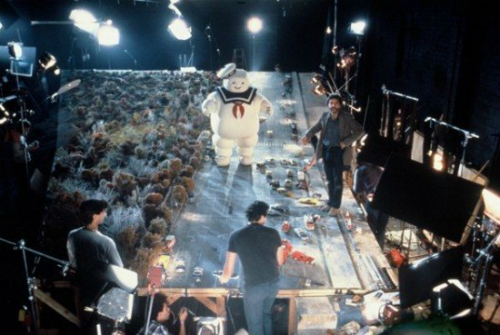
I love looking at old behind the scenes pics. Seeing actors with their guards down, seeing how effects wee made. Here's just a few of my favourites.
John Milius instructing Arnold Schwarzenegger how to look tough.
Holy cow! The Stay Puft Marshmallow Man was just a guy in a suit?
Turns out filming Psycho was actually a lot of fun!
Friday, May 31, 2013
Thursday, May 16, 2013
Underrated Adventure: The Wind and the Lion (1975)
There's two things you have to accept in order to enjoy The Wind and the
Lion. The first is that though the film is based
on a true historical events it has been very loosely adapted by the
writer/director John Milius. Some of the alterations are minor changes,
other are very large. For instance, the main character in the film Eden
Pedecaris, played by the beautiful Candice Bergen, was in real life a 66
year old man called Ion Perdecaris.
The second thing you have to accept is that Sean Connery is playing a
Moroccan outlaw called Mulai Ahmed er Raisuli. I'll say that again Sean
Connery is playing a Moroccan outlaw and just like every other role he's
played from The Hunt for the Red October to The Untouchables, he doesn't make any alterations to his thick Scottish accent. You've just got to go with it.
The Wind and the Lion
begins in 1904 with the Raisuli and his men kidnapping Eden Pedecaris
along with her son and daughter from their house in Morocco. With Eden
being an American citizen, President Theodore Roosevelt (Brian Keith) is
forced to take the matter seriously. He's up for re-election and how he
deals with the kidnapping situation could make or break him as a
politician. Meanwhile, it turns out the Raisuli has actually staged the
kidnapping purely in the hope that it will cause a major public
embarrassment for the Sultan of Morocco and incite a civil war in the
country. The Raisuli has no hostile intentions with Eden, he has no
hostility towards her and purely needs her as a pawn in his plans. As
the kidnapping goes on Roosevelt is forced to turn to ever more
desperate measures to mount a rescue effort and eventually set out his
decree "Pedecaris alive or Raisuli dead!"
Despite the odd casting choices and liberal approach to history The Wind and the Lion is a masterpiece of cinema. I absolutely love this film. The acting is top notch across the board. Though Connery is exceedingly charismatic as the Raisuli, it's Brian Keith's wonderfully stiff and mannered portrayal of Roosevelt that sticks in your mind after the credits roll. What's brilliant about the film is that it has several layers. On the surface you have an exciting kidnap and rescue story with all the usual trappings like the kidnappee slowly coming around to the kidnapper's point of view. But underneath there's a lot more going on. The film is really a character study of the Raisuli and Roosevelt. Two powerful men from very different worlds who are trying to show their strength to the rest of the world.
The two men never meet at any point in the
film and their only communication is via a letter at the very end of the
film in which the Raisuli perfectly sums up their differences. "I, like
the lion, must stay in my place, while you, like the wind, will never
know yours." That's such a perfect metaphor for both their countries and
their characteristics. The Raisuli is a descendant of the Barbary
Pirates, he is expected to be dangerous and unpredictable. While
Roosevelt is a civilised man from the still quite young United States.
Roosevelt is trying to win an election, Raisuli is trying to incite war.
Very different ways of becoming rulers of countries. And yet, there is a
commonality I think that Milius wants us to see between them. They both
do cowardly things during the course of the film. The Raisuli,
obviously, kidnaps an innocent woman. Roosevelt shoots a grizzly bear
and has it stuffed for a museum. Despite being at opposite ends of the
battlefield they are not so different.
Anyway, that's enough metaphorical musings I've got to talk about Jerry Goldsmith's stunning score as well. It's a wonderfully epic, soaring, bombastic piece. I don't know why it's not more well known among his work. Yes, it sounds a little bit like Maurice Jarre's score for Lawrence of Arabia in places but I think that was intentional. There's no doubt that Milius was inspired by David Lean's earlier film. Anyway, it perfectly compliments the film and works particularly well during the intense action scenes. I don't think I've seen another film that had so many horses falling over (which is also possibly why it's not been released on DVD in the UK - our censors always cut out horses falling over!)
So
was it bad idea to cast Connery? Should Milius have changed Pedecaris
to a woman? In answer to the first question, apparently Omar Sharif was
intended to take the role of the Raisuli but dropped out. As much as I
like Sharif, I'm glad Connery was cast instead. He's a superior actor
and brilliant at playing likable rogues. As for changing Pedecaris to
woman I can see Milius' reasoning. Firstly, there's no other female
characters in the film, it needed at least one. Secondly, having
Pedecaris be a woman allows for a hint of romance and this is mostly
definitely a Romantic adventure.
Bottom line is if you haven't seen this film go see it now.
GRADE: A+
The Wind and the Lion
begins in 1904 with the Raisuli and his men kidnapping Eden Pedecaris
along with her son and daughter from their house in Morocco. With Eden
being an American citizen, President Theodore Roosevelt (Brian Keith) is
forced to take the matter seriously. He's up for re-election and how he
deals with the kidnapping situation could make or break him as a
politician. Meanwhile, it turns out the Raisuli has actually staged the
kidnapping purely in the hope that it will cause a major public
embarrassment for the Sultan of Morocco and incite a civil war in the
country. The Raisuli has no hostile intentions with Eden, he has no
hostility towards her and purely needs her as a pawn in his plans. As
the kidnapping goes on Roosevelt is forced to turn to ever more
desperate measures to mount a rescue effort and eventually set out his
decree "Pedecaris alive or Raisuli dead!"Despite the odd casting choices and liberal approach to history The Wind and the Lion is a masterpiece of cinema. I absolutely love this film. The acting is top notch across the board. Though Connery is exceedingly charismatic as the Raisuli, it's Brian Keith's wonderfully stiff and mannered portrayal of Roosevelt that sticks in your mind after the credits roll. What's brilliant about the film is that it has several layers. On the surface you have an exciting kidnap and rescue story with all the usual trappings like the kidnappee slowly coming around to the kidnapper's point of view. But underneath there's a lot more going on. The film is really a character study of the Raisuli and Roosevelt. Two powerful men from very different worlds who are trying to show their strength to the rest of the world.
The two men never meet at any point in the
film and their only communication is via a letter at the very end of the
film in which the Raisuli perfectly sums up their differences. "I, like
the lion, must stay in my place, while you, like the wind, will never
know yours." That's such a perfect metaphor for both their countries and
their characteristics. The Raisuli is a descendant of the Barbary
Pirates, he is expected to be dangerous and unpredictable. While
Roosevelt is a civilised man from the still quite young United States.
Roosevelt is trying to win an election, Raisuli is trying to incite war.
Very different ways of becoming rulers of countries. And yet, there is a
commonality I think that Milius wants us to see between them. They both
do cowardly things during the course of the film. The Raisuli,
obviously, kidnaps an innocent woman. Roosevelt shoots a grizzly bear
and has it stuffed for a museum. Despite being at opposite ends of the
battlefield they are not so different. Anyway, that's enough metaphorical musings I've got to talk about Jerry Goldsmith's stunning score as well. It's a wonderfully epic, soaring, bombastic piece. I don't know why it's not more well known among his work. Yes, it sounds a little bit like Maurice Jarre's score for Lawrence of Arabia in places but I think that was intentional. There's no doubt that Milius was inspired by David Lean's earlier film. Anyway, it perfectly compliments the film and works particularly well during the intense action scenes. I don't think I've seen another film that had so many horses falling over (which is also possibly why it's not been released on DVD in the UK - our censors always cut out horses falling over!)
So
was it bad idea to cast Connery? Should Milius have changed Pedecaris
to a woman? In answer to the first question, apparently Omar Sharif was
intended to take the role of the Raisuli but dropped out. As much as I
like Sharif, I'm glad Connery was cast instead. He's a superior actor
and brilliant at playing likable rogues. As for changing Pedecaris to
woman I can see Milius' reasoning. Firstly, there's no other female
characters in the film, it needed at least one. Secondly, having
Pedecaris be a woman allows for a hint of romance and this is mostly
definitely a Romantic adventure.Bottom line is if you haven't seen this film go see it now.
GRADE: A+
Subscribe to:
Comments (Atom)